
Journal · · 5 min read
How to keep the same AI model in every campaign image
Decide who your athlete is before you make a single image, then lock that person down with reference images or a trained identity and check every frame against the first one. AI tools drift on faces, hair and build from one generation to the next, so consistency comes from a fixed character sheet and a human eye, not from the prompt alone.

Why does it matter if it's the same person in every frame?
Because people recognise faces faster than they read logos. When the same runner shows up in your carousel on Monday, your retargeting ad on Thursday and your email on Sunday, the viewer starts to feel they know this brand. A new stranger in every ad resets that feeling each time.
It also holds a story together. In how to tell a story with campaign images I described the four beats I use: gear up, effort, payoff, detail. That arc only reads as one story if it is clearly one person moving through it. If the runner at the trailhead has different cheekbones from the runner at the top, the viewer sees four separate ads.
Why do AI faces keep changing between images?
A text prompt describes a type of person, not a specific one. "Woman in her thirties, dark ponytail, lean runner's build" fits thousands of faces, and the model picks a new one every time you hit generate. Change the angle, the light or the crop and it fills in the gaps differently again.
The tools know this, and the better ones now offer ways to hold an identity. Midjourney's Character Reference lets you supply an image of a character so it carries across new images, with a weight setting that ranges from the whole look down to mainly the face (for V7 it points you to Omni Reference instead). Higgsfield's Soul ID trains on 20 to 80 photos of one person and then applies that face to new generations. Both are useful, and I use this kind of tool in production.
Both vendors are also honest about the limits. Midjourney's documentation says references are used as inspiration rather than copied exactly, and that fine details like freckles or logos on clothing might not come out exactly right. Higgsfield's help page describes the result as clearly the same person rather than a pixel-identical face, and says one Soul ID holds one person. So the tools get you most of the way. The last part is judgment.
How do you actually keep a character consistent?
This is the process I use for every campaign:
- Cast before you shoot. Write a short character note: age range, build, hair, skin, how they carry themselves, what sport they look like they really do. A trail runner and a gym athlete stand differently.
- Make a character sheet. Generate the person front, three-quarter and profile in neutral light, pick the one that fits the brand, and treat that sheet as the master reference for the whole set.
- Fix what the face can't carry. Hairstyle, facial hair, watch, sunglasses, the way a cap sits. These small anchors do a lot of the work when the face is turned away or in shadow.
- Keep the light family. The same face in warm low sun and flat overcast can look like two people. Pick one light and hold it across the set.
- Check every frame against frame one. Side by side, at full size. Eye shape, nose, jawline, hairline, ears, build. If one drifts, it gets regenerated or retouched in Photoshop, never shipped.
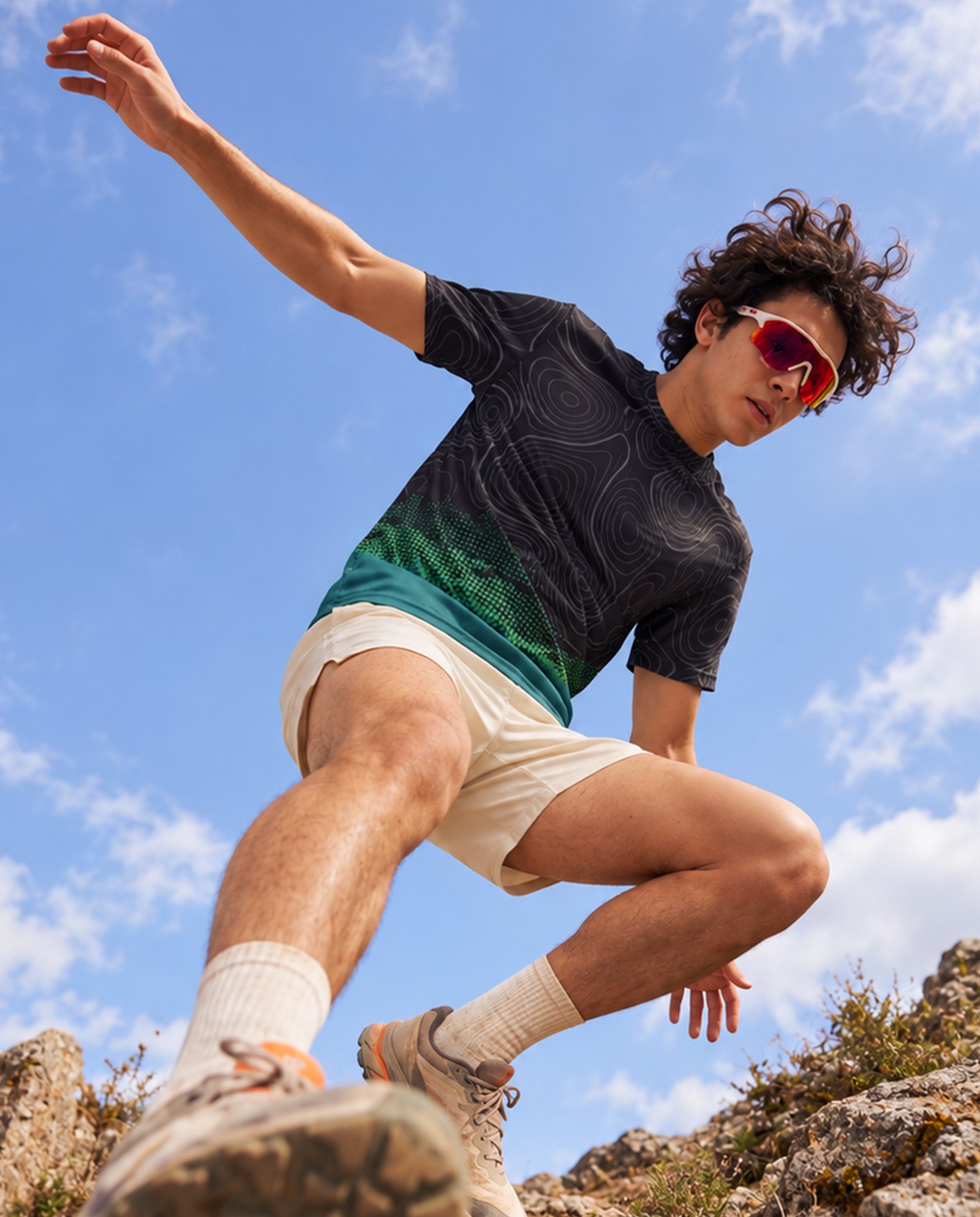
The frame above is from a topo tee set where the same runner appears in every image. The curly hair and the red-lensed sunglasses carry from shot to shot, so even in the wide or low-angle frames where his face is small, he reads as the same person.
What else drifts besides the face?
Body shape is the one people miss. If your athlete is lean in one frame and broad-shouldered in the next, the garment hangs differently, and that matters more for an apparel brand than almost anything else. A tee that skims a runner's frame in one ad and pulls across a bigger chest in another tells the customer two different stories about fit. I spent years designing clothing for an outdoor apparel brand, and fit was always what customers asked about first. There is more about that background here.
Skin tone, age and height drift too, especially across different light. All of these get the same side-by-side check as the face.
When should you use different people on purpose?
Consistency is a tool, not a rule. There are good reasons to cast more than one person:
- Different products for different customers. If your women's and men's lines speak to different buyers, give each its own recurring athlete.
- A crew story. Some outdoor moments are social: a group run, a shared summit. Here the consistency moves from one face to a fixed cast, and each person still stays the same across frames.
- Showing range. If your brand is about everyone who runs or climbs, a deliberate mix of ages and builds says that. The key word is deliberate. Planned variety looks like a choice. Random variety looks like a tool picking faces.
Whatever you choose, decide it at the concept stage, before the first image. This is the same point I made in why one great AI image isn't a campaign: the things you keep fixed across a set are what make it a campaign.
Can automated ad tools keep my model consistent?
Some can hold a face if you give them a strong reference, and they are excellent for speed. But tools that spin out many variations are built to explore, and exploring means trying new people, new light and new settings. That is useful for testing and works against a recurring character. I wrote about that trade-off in why automated ad tools miss your brand.
In my process the character is set by me at the concept stage, AI produces each frame from the character sheet, and every face, logo, zip, seam and print is hand-checked in Photoshop before delivery. That is how the test set and monthly creative work, and the person you meet in the first six images can carry into every month after.
If you want to see one consistent athlete wearing your product across a full set, start with a $200 test set: 6 images, one concept, within 3 days.
Quick answers
How do I keep the same AI model across multiple images?
Create a character sheet first (front, three-quarter and profile), use it as a reference or train an identity tool on it, keep the light consistent, and check every frame side by side against the first one, fixing any drift before it ships.
Why does my AI character's face change every time?
A text prompt describes a type of person, not one specific person, so the model fills in a new face each generation. Reference features like Midjourney's Character Reference or Higgsfield's Soul ID reduce drift, but both vendors say the result is close rather than an exact copy.
Should every ad for my apparel brand use the same model?
Usually one recurring athlete per product line or campaign builds the most familiarity. Use different people on purpose when you are telling a crew story, speaking to a different customer, or showing range, and keep each of those people consistent too.